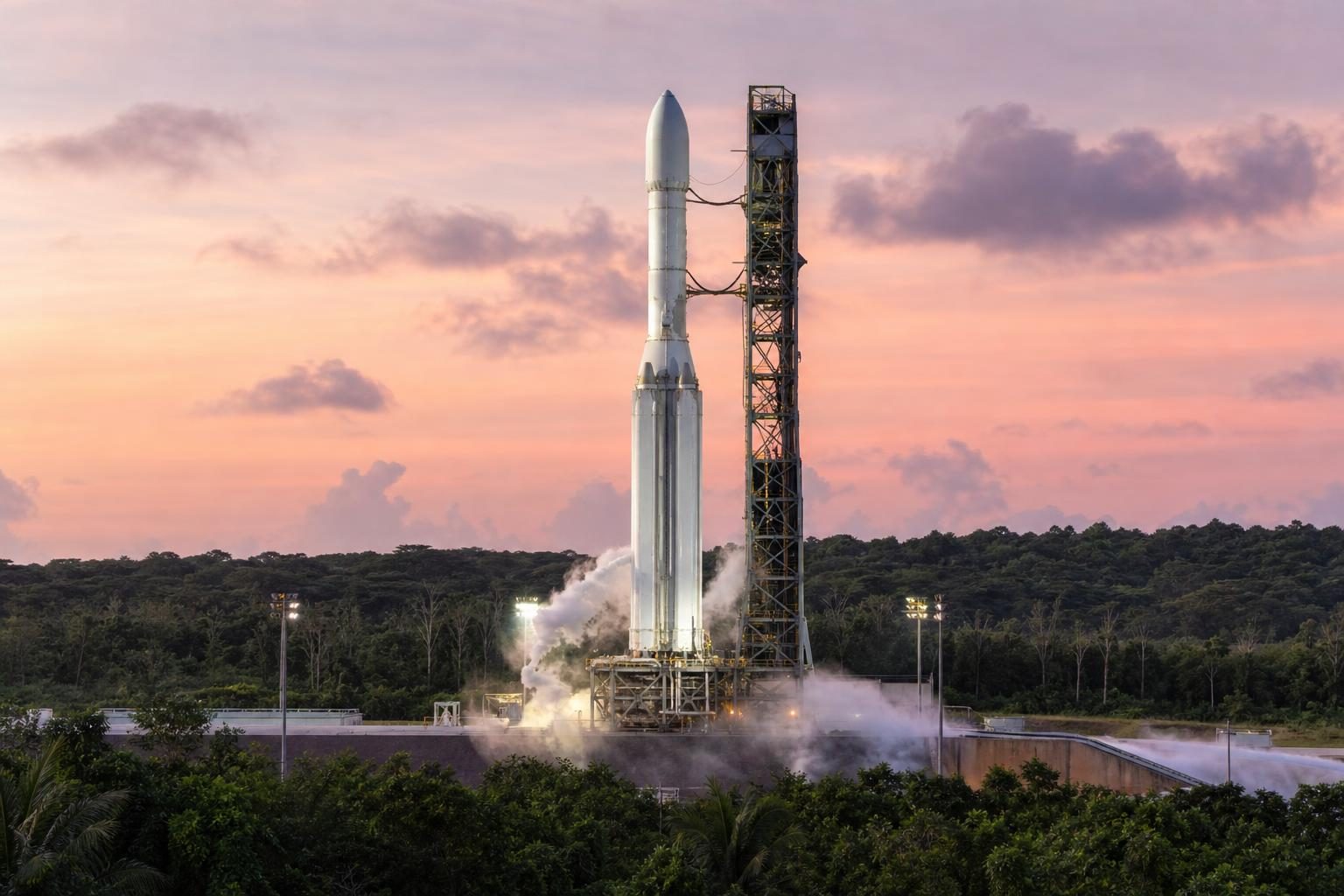
A European rocket is scheduled to lift off from French Guiana at 6:09 a.m. Eastern, Amazon's first satellite launch since the Vulcan failure that set back its Starlink challenger.
By HANNAH LINDGRENScience & Space · Nov 23, 3:00 AM
WASHINGTON — Eight days after a United Launch Alliance Vulcan Centaur failed and took 40 Amazon Leo internet satellites down with it, Amazon is set to try again this morning on a European rocket, Space.com reported.
An Arianespace Ariane 6 is scheduled to lift off from Europe's Spaceport…
Continued: read the full story »
A four-year study that tested the blood of more than 5,700 children adds strong evidence that a natural bacterium can turn the mosquito from carrier into shield, without new pesticides.
By HANNAH LINDGRENScience & Space · Nov 22, 11:25 PM
WASHINGTON — Scientists have reported some of the strongest evidence yet that a simple, natural bacterium can help protect whole neighborhoods from dengue, the painful mosquito-borne illness sometimes called breakbone fever.
In a large randomized trial in Belo Horizonte, Brazil, neighborhoods that received…
Continued: read the full story »
No storm is forecast, but a moderate burst of solar activity could paint the sky green along the Canadian border, and the best odds may come in the early hours of Monday.
By HANNAH LINDGRENScience & Space · Nov 22, 10:00 PM
WASHINGTON — If you live along the Canadian border and the clouds cooperate, it may be worth stepping outside late tonight. The northern lights have a chance to be visible Sunday night into Monday morning from parts…
Continued: read the full story »
Sherrie James gave the meteorite that hit her home to the Houston Museum of Natural Science, where its fragments anchor the new 'Fall to Earth' exhibit.
By HANNAH LINDGRENScience & Space · Nov 22, 7:00 PM
TEXAS — Earlier this year, a rock as old as the solar system itself fell out of the Texas sky and crashed into Sherrie James' home in the Houston area. No one was hurt, and this fall…
Continued: read the full story »
Australian scientists trained an algorithm on everyday photos, then turned it loose on Event Horizon Telescope data from the galaxy M87. It found the same glowing ring astronomers unveiled in 2019, answering skeptics who called it an artifact.
By HANNAH LINDGRENScience & Space · Nov 22, 11:31 AM
WASHINGTON — Seven years after astronomers showed the world its first picture of a black hole, a team of scientists who had no part in making it has checked the work, and the famous glowing ring has…
Continued: read the full story »
Only the second mission ever to orbit the solar system's innermost planet arrived Saturday after an autonomous braking burn, a year-long delay and a long, anxious wait for confirmation. Here is what it will try to learn, and what comes next.
By HANNAH LINDGRENScience & Space · Nov 21, 10:00 PM
WASHINGTON — Mercury has company again. On Saturday, the European-Japanese BepiColombo mission slipped into orbit around the smallest and innermost planet in our solar system, ending a cruise of more than eight years and opening a new…
Continued: read the full story »
The new Moon Base Student Challenge asks young Americans to tackle power, construction, life support and astronaut safety. No engineering degree required, and registration is open until Jan. 25.
By HANNAH LINDGRENScience & Space · Nov 21, 3:00 PM
NORTH CAROLINA — America is going back to the Moon to stay, and NASA wants the next generation of engineers, builders and dreamers to help figure out how.
The space agency has launched the Moon Base Student Challenge, a competition…
Continued: read the full story »
A researcher at Anthropic says he and the company's Claude program have proved the Riemann hypothesis. Outside mathematicians have not yet checked the work.
By HANNAH LINDGRENScience & Space · Nov 20, 5:33 PM
WASHINGTON — A mathematician at the artificial intelligence company Anthropic said Friday that he has found a proof of the Riemann hypothesis, the 167-year-old puzzle about prime numbers that many consider the most important unsolved problem in…
Continued: read the full story »
Shanghai authorities removed the lead researcher and banned him from research after a probe into a child's death that went unmentioned in his published paper.
By HANNAH LINDGRENScience & Space · Nov 20, 4:35 AM
WASHINGTON — A 6-year-old girl died after receiving an experimental gene-editing treatment in China for a condition that was not life-threatening, and the scientist who led the work has been fired, CBS News reported, citing Chinese state…
Continued: read the full story »
Plants raised in moon-like dirt mixed with worm compost matched those grown in Earth soil, a hopeful step toward feeding astronauts on long missions.
By HANNAH LINDGRENScience & Space · Nov 19, 7:00 PM
OREGON — Scientists at Oregon State University say they have grown potatoes through their full life cycle in soil designed to mimic the surface of the moon, a result that could help astronauts one day grow their…
Continued: read the full story »
A radio hello now takes a full day to reach the probe and another day to come back, and the little spacecraft built with 1970s technology is still sending science from interstellar space.
By HANNAH LINDGRENScience & Space · Nov 18, 11:31 AM
CALIFORNIA — Far beyond the planets, a spacecraft that left Earth nearly half a century ago crossed an invisible line on Wednesday that no human-made object had ever reached. Voyager 1 is now one light-day from Earth,…
Continued: read the full story »
The first outright failure for United Launch Alliance sends engineers hunting for answers, sets back Amazon's race with Starlink and raises fresh questions about America's ride to orbit.
By HANNAH LINDGRENScience & Space · Nov 15, 8:30 PM
FLORIDA — United Launch Alliance's Vulcan rocket failed Sunday on what was meant to be its comeback flight, losing all 40 Amazon Leo internet satellites on board after an anomaly roughly 10 minutes after liftoff from Florida,…
Continued: read the full story »
A day after its booster was lost in the Gulf, Ship 42 came back from nearly 22 hours in orbit and was plucked out of the air at Starbase, the first time a spaceship has been recovered this way.
By HANNAH LINDGRENScience & Space · Nov 14, 8:30 PM
TEXAS — For the first time, a spaceship has come home from orbit and been caught in midair by the tower that launched it.
SpaceX's Starship upper stage, known as Ship 42, descended from orbit on Saturday…
Continued: read the full story »
Launched in 1977, NASA's farthest spacecraft is days from a distance so great that its signals need a full day to reach home, and it is still sending data.
By HANNAH LINDGRENScience & Space · Nov 14, 3:00 PM
FLORIDA — Sometime before dawn on the East Coast next Wednesday, a machine built in the 1970s will cross a line no human-made object has ever crossed. NASA's Voyager 1 is set to reach one light-day from…
Continued: read the full story »
Two small earthquakes shook the high desert near Preston, Nevada, on Friday morning, a reminder that the Basin and Range is stretching and that wise households prepare.
By HANNAH LINDGRENScience & Space · Nov 14, 1:15 AM
NEVADA — Friday morning brought a jolt, and then another, to the remote high desert of eastern Nevada. The Daily Mail reported that two earthquakes struck within seconds of each other near the small community of Preston,…
Continued: read the full story »
The Super Heavy booster was sent into the Gulf by an automatic abort and exploded, but Ship 42 reached orbit, released 26 Starlink satellites and is still headed for a first-ever tower catch on Saturday afternoon.
By HANNAH LINDGRENScience & Space · Nov 13, 10:00 PM
TEXAS — SpaceX's boldest Starship test began Friday evening with a clean climb out of South Texas and a setback only minutes later. The giant upper stage reached orbit and delivered a full load of next-generation Starlink…
Continued: read the full story »
The Leonids peak around Monday night, Nov. 17. The show will be modest this year, but the shower's history, from a famous 1833 storm to 1966's deluge, makes it worth an hour under the sky.
By HANNAH LINDGRENScience & Space · Nov 13, 2:15 PM
WASHINGTON — Some of the best shows of the year cost nothing and require no ticket. Next week, one of them returns. The Leonid meteor shower, one of the most storied displays in the night sky, reaches…
Continued: read the full story »
Flight 15 lifts off from South Texas as early as 5:45 p.m. Eastern. The booster comes home in minutes; the ship flies 22 hours, crosses the Rio Grande Valley and tries to land in the tower's arms on Saturday.
By HANNAH LINDGRENScience & Space · Nov 13, 9:30 AM
TEXAS — On Friday the 13th, of all days, SpaceX will try something no one has ever done: catch both halves of an orbital rocket as they come home. If it works, the giant Starship system will…
Continued: read the full story »
The Global Carbon Project projects a 0.4% decline in fossil CO2 this year, the first since 2020, with oil use squeezed by the Iran war and U.S. coal burning falling back.
By HANNAH LINDGRENScience & Space · Nov 12, 7:00 PM
WASHINGTON — Global fossil-fuel carbon dioxide emissions are on course to fall this year for the first time since 2020, according to the Global Carbon Project's Global Carbon Budget, but its scientists say the biggest factor is…
Continued: read the full story »
Four years after America's DART mission knocked a small asteroid off its path, ESA's Hera has begun close-up studies of Didymos and Dimorphos to learn exactly what the impact did, and how to do it again if Earth ever needs it.
By HANNAH LINDGRENScience & Space · Nov 12, 7:00 AM
CALIFORNIA — Four years after America slammed a spacecraft into an asteroid to see whether humanity could nudge a threat off course, Europe has arrived to inspect the damage. The European Space Agency's Hera spacecraft has begun…
Continued: read the full story »