 Last night on Mother & Child with Elena Vasquez
Called by Name: Reports Say the Taliban Are Erasing Women's Names From Records in Balkh
Afghan activists say officials in the northern province were told to stop writing women's names, even on prescriptions. It is the latest step in five years of pushing women out of public life.
Filed November 28, 2026 · 📍 NY 12207
Were you there? Share your story
Key points
- Taliban authorities in Balkh province have reportedly barred women's names from official and medical documents.
- The reports, first published by El País, rely on activists and health workers; no written decree has been made public.
- Afghan women won the right to have mothers' names on children's ID cards in 2020, before the Taliban returned.
- UN Women says more than half of Afghan women now leave home twice a month or less.
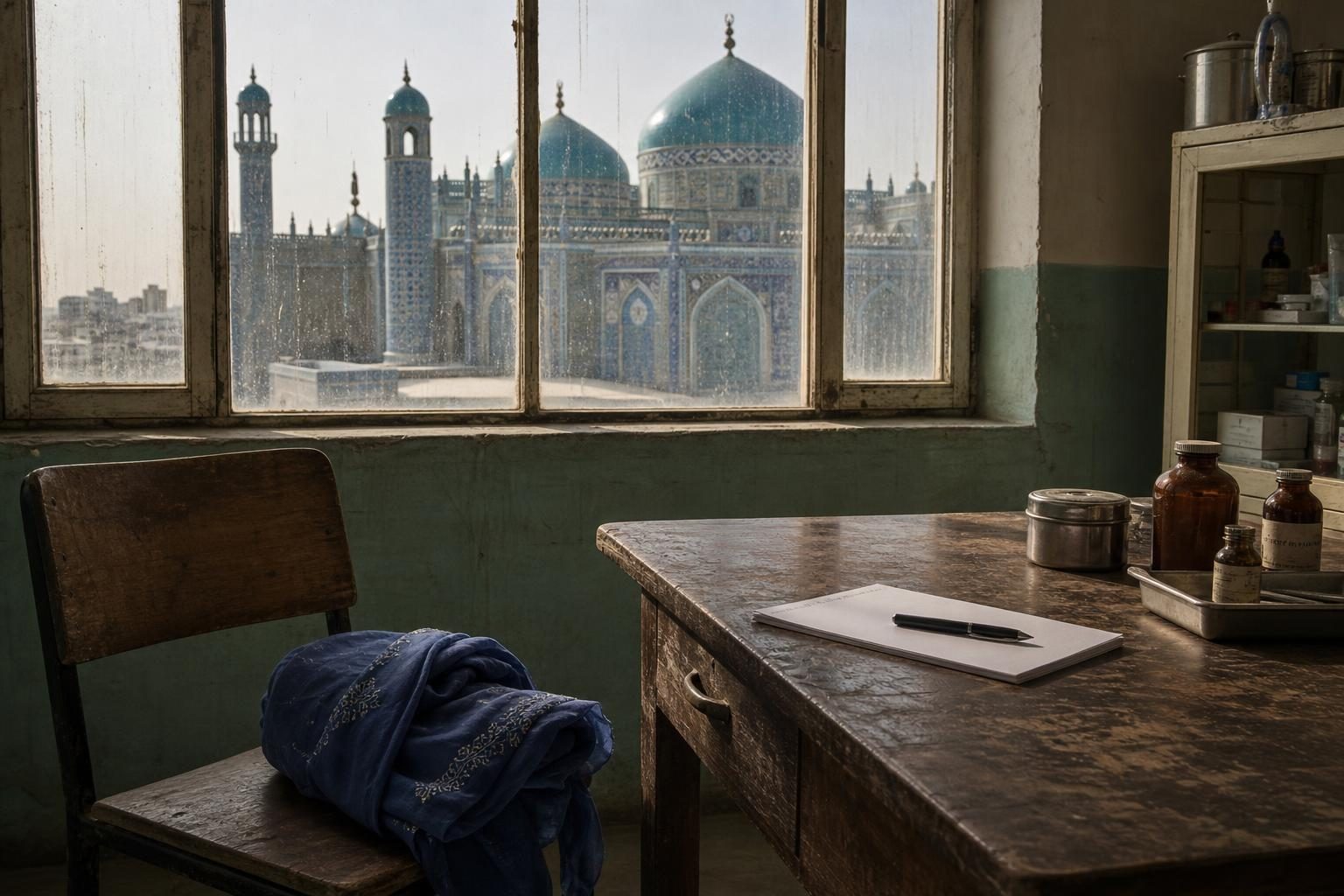
A woman in northern Afghanistan who walks into a clinic this week may leave with a prescription that does not carry her own name. Taliban authorities in Balkh province have reportedly barred officials from writing women's names on official and medical documents, the New York Post reported, raising fears that the rule could spread across the country [1].
The accounts trace back to reporting by the Spanish newspaper El País, which spoke with Afghan activists, doctors and women in the province, according to the Times of India [3]. Staff were told to refer to women as "Bibi," an honorific, the reports said, and a Germany-based Afghan women's rights activist told the paper that some women have been labeled with degrading animal terms instead [3]. Fox News, which also carried the reports, noted that the move comes five years after the Taliban retook power during the chaotic U.S. withdrawal [2].
What We Know and What We Don't
Some care is in order. The reports rest on the accounts of activists, doctors and women in the province, as gathered by El País [3]. One activist in Kabul told the paper that, so far, the order had largely been ignored, according to the Times of India [3]. How widely and how strictly it is enforced remains to be seen.
But the direction is not in doubt, because Afghan women have seen this before. In many Afghan families, a woman's name has long been kept out of public view, and official papers have traditionally identified people through their fathers. In 2017, activist Laleh Osmany started the "Where Is My Name?" campaign to change that, and it stirred fierce debate before Afghanistan's then-government moved in 2020 to let mothers' names appear on their children's identity cards, Dawn reported [4]. The Taliban's return in 2021 put every one of those gains at risk.
Five Years of Erasing Women
The Balkh order, if it holds, fits a pattern that the United Nations has documented in detail. Girls have been shut out of school past the primary grades, women have been pushed out of most work and public life, and UN Women reported in August that more than half of Afghan women now leave their homes twice a month or less [5].
Taking away a woman's name is a quieter step than closing a school, but it may cut just as deep. A name on a medical chart is how a nurse knows whose blood test came back, whose allergy is noted, whose prescription is in the bag. Strip the name away, and a woman becomes harder to treat, harder to track and easier to forget. For women whose access to care is already narrow, that is not a small thing. It is one more wall between a mother and the care she and her children need.
Why It Matters to Us
Christians have a particular reason to pay attention. Scripture begins with the claim that every woman and every man is made in the image of God, and it returns again and again to the dignity of being known by name. Through the prophet Isaiah, God tells His people, "I have called thee by thy name; thou art mine." When Jesus healed the woman who touched His cloak, He did not send her off unnamed into the crowd. He stopped, looked for her and called her "Daughter."
A regime that will not let a woman's name be written down is saying the opposite: that she does not count as a person in her own right. Americans who believe in equal dignity under God should say so plainly.
What Comes Next
The worry now is that Balkh is a test run. Activists fear that a local rule could become a national one [1]. Here at home, the stakes are personal for Afghan women who fled. CBS News reported this week that some who escaped Taliban rule still live in anxiety and legal limbo in America, even as the threat of immediate deportation has eased [6]. Their stories, and their names, are a reminder of what is being taken from the women who could not leave.
Sources
- [1]New York PostTaliban strips women of their names in Afghan province, now being called 'goat' or 'grandmother'Opens in a new tab ↗
- [2]Opens in a new tab ↗
- [3]The Times of IndiaAfghan women reduced to 'Bibi', 'Goat' as Taliban reportedly bans their names from official documentsOpens in a new tab ↗
- [4]Opens in a new tab ↗
- [5]Opens in a new tab ↗
- [6]Opens in a new tab ↗
Israel's new parliament is sworn in. Who would you rather see lead Israel?
- Benjamin Netanyahu
- Gadi Eisenkot
- Someone new
- That's for Israelis to decide
More in World News
Bombs Hit a Wedding and a School as Myanmar's Military Strikes Kill Dozens
Yesterday on Cross-Examination with Dominic Kane
Netanyahu Offers Eisenkot the First Turn as Prime Minister in a Unity Deal
Yesterday on World Watch with Grace Whitfield
Taiwan Votes Under Beijing's Shadow: The Ruling Party Gains, the KMT Keeps Taipei, and a Pro-Nuclear Yes Leads the Count
Yesterday on Cross-Examination with Dominic Kane
Were you there?
If you were at the scene, or this story touched your life, tell us what you saw and what it was like.
Discussion 0
Sign in or create a free account to join the discussion.
No comments yet. Start the discussion.