
 Yesterday on America’s Forecast with Savannah Reed
As El Niño Floods Ecuador and Peru, NOAA Sees a Wetter Winter for the South
Ecuador's risk agency counts 34 dead in its El Niño emergency and Peru's Piura is under waist-high water. The same Pacific warm-up is tilting U.S. winter odds wetter across the Southeast.
Filed November 28, 2026 · 📍 Washington, DC 20001
Were you there? Share your story
Key points
- Ecuador reports 34 deaths and about 47,000 people affected in its El Niño rain emergency
- Waist-high water filled Piura, Peru, after 12 hours of rain; a hospital ward was moved
- NOAA expects a strong El Niño through winter, with wetter odds for the Southeast
- New flood insurance policies usually take 30 days to start, so families should not wait
Two of our neighbors on South America's Pacific coast are under water this weekend, and the warm ocean behind their floods is the same one shaping the winter ahead for millions of American families.
In Ecuador, the National Secretariat for Risk Management reported Friday that 34 people have died and about 47,000 have been affected by heavy rains tied to El Niño across the country, Al Jazeera reported [1]. Across the border in northern Peru, the city of Piura woke to streets filled with waist-high water after roughly 12 hours of downpours that began Thursday [1]. Both countries have declared national emergencies over El Niño [1].
Ecuador's Toll Keeps Climbing
Ecuador's figure is a running count, not one day's losses. The Peruvian business daily Gestión reported that Ecuador declared its emergency on Aug. 29, and that since then the risk agency has also recorded 23 injuries and about 31,000 damaged homes [2]. In its latest 24-hour report, the agency logged two deaths and 37 emergencies spread across 15 provinces, including two cases in coastal Manabí, the Guayaquil newspaper El Universo reported [3].
Manabí's port city of Manta has taken some of the worst of it in recent days. Two rivers there broke their banks, leaving residents wading through deep water, according to Al Jazeera [1].
History explains why officials are uneasy. Gestión recalled that the strongest El Niño since 1950, the 1997-98 event, left nearly 300 people dead in Ecuador by official count [2]. Nobody wants a repeat, and NOAA expects this El Niño to last into early 2027 [4].
Piura Under Water
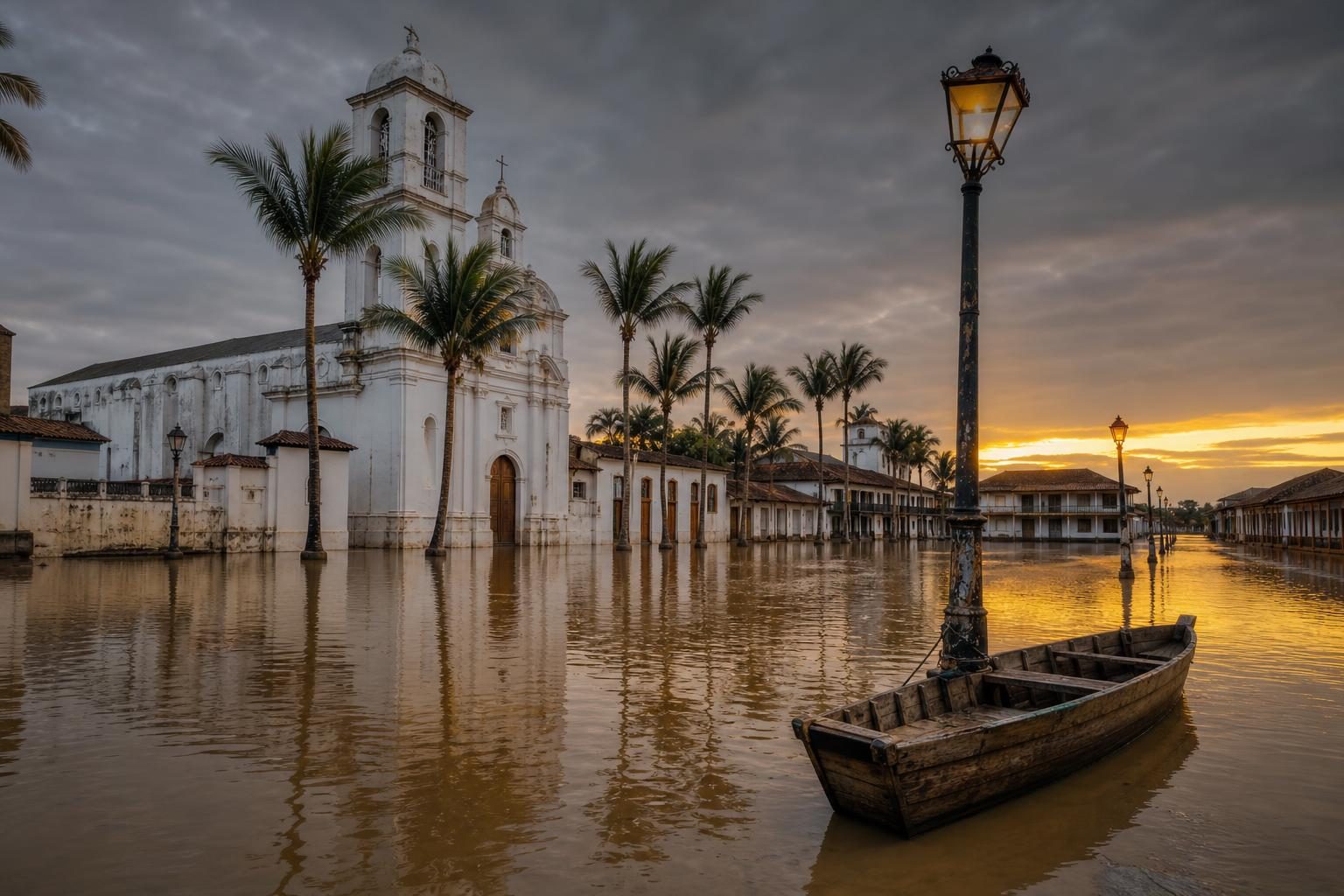
In Piura, floodwater reached the city's main square, the Plaza de Armas, Al Jazeera reported [1]. Rising water forced staff at the José Cayetano Heredia Hospital to move patients out of the ward for respiratory infections and into the hospital's auditorium [1]. Luis Vásquez, the head of Peru's National Institute of Civil Defense, said preliminary reports showed about 2,000 families affected [1].
Peru's armed forces sent personnel and pumping equipment to drain flooded neighborhoods, though some residents complained that machines stopped because they had run out of fuel [1]. Peru's national weather service warned that moderate to heavy rain could keep falling on parts of the region for four more days [1].
What It Means for American Families
El Niño is a periodic warming of the tropical Pacific, and its reach does not stop at the equator. NOAA's Climate Prediction Center kept its El Niño Advisory in place in its November discussion and expects a strong event to hold through the winter and into early 2027 [4].
For the United States, the clearest signal is rain. NOAA's winter outlook tilts the odds toward a wetter-than-normal season across the Southeast, and forecasters said they have more confidence in that precipitation outlook than in the temperature outlook, according to the federal Drought.gov service [5]. That is good news for farmers and ranchers who have watched pastures and ponds run low. It also raises the flood risk for families in low-lying neighborhoods along rivers and the coast [5].
Here is the practical part. If you live in a flood-prone area and have been meaning to buy flood insurance, do not wait for the first big storm: a new National Flood Insurance Program policy typically does not take effect until 30 days after purchase, FEMA says [6].
A strong El Niño is no reason to panic. It is a reason to prepare: clear the gutters and storm drains around your home, know your evacuation route if you live near water, keep a few days of food, water and medicine on hand, and check on the older neighbors on your street when the heavy rain comes. That kind of readiness has always been the American way, and it starts at home, not in Washington.
What to Watch
In the days ahead, watch for Peru's four-day rain warning in the north, updated casualty counts from Ecuador's risk agency, and NOAA's next monthly El Niño update in December [1][3][4]. And keep the families of Manta and Piura in your prayers this weekend. They are cleaning up from one storm while bracing for the next.
Sources
- [1]Opens in a new tab ↗
- [2]Opens in a new tab ↗
- [3]Opens in a new tab ↗
- [4]NOAA Climate Prediction CenterENSO Diagnostic Discussion, November 2026Opens in a new tab ↗
- [5]Opens in a new tab ↗
- [6]Opens in a new tab ↗
Do you trust the 10-day forecast?
- Yes
- Only the first few days
- Not really
More in Weather & Natural Disasters
600,000 Still in the Dark as the Thanksgiving Storm Lets Go
On Friday on America’s Forecast with Savannah Reed
Higher Than Sandy at Some Gauges: Thanksgiving Nor'easter Floods the Jersey Shore and Cuts Off the Wildwoods
On Thursday on America’s Forecast with Savannah Reed
Storm Soaks Thanksgiving, Scrubbing Flights and Parades
On Thursday on America’s Forecast with Savannah Reed
Were you there?
If you were at the scene, or this story touched your life, tell us what you saw and what it was like.


Discussion 0
Sign in or create a free account to join the discussion.
No comments yet. Start the discussion.